We wrote a trends piece at the start of 2025. Nineteen months and a few hundred consultations later, some of those calls held up, one did not, and several new patterns have emerged. Here is where things actually stand across Orange County and Los Angeles County in 2026.
1. Dark Finishes Are No Longer a Trend, They Are the Default
In 2025 we described a shift toward charcoal, bronze, and matte black as emerging. It is done. Dark finishes now outsell white and almond on our residential work, and matte black in particular has become the standard request on contemporary and transitional homes.
One practical note that comes up constantly: a dark finish does absorb more heat than a light one. On an insulated cover the foam core means you never feel it underneath, so the choice is purely aesthetic. On a single-skin non-insulated pan, a dark top surface is more noticeable on a 100°F afternoon.
2. Two-Tone Is the New Refinement
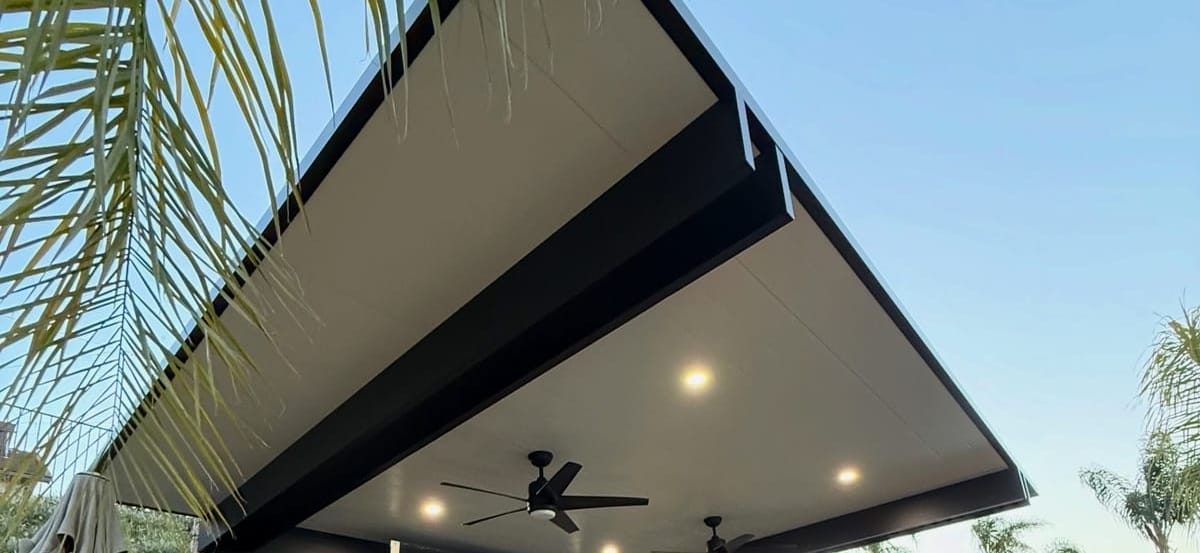
The most-requested detail of the past year is a dark frame with a light or woodgrain underside. You get the modern silhouette from the yard and a warm, bright ceiling from underneath — and because the ceiling reflects rather than absorbs light, the covered space feels considerably less cave-like than an all-black build. Expect to see a lot more of this.
3. Woodgrain Finishes Got Convincing
Woodgrain powder coats have improved enough that we now regularly install them for homeowners who wanted the look of a timber structure and none of the maintenance. From a normal viewing distance the effect is genuinely persuasive, and it carries all of aluminum's durability advantages over real wood.
4. Louvered Systems: Mainstream Consideration, Selective Purchase
Our 2025 prediction that louvered systems would gain momentum was half right. Nearly every homeowner now asks about them — that part happened. But the price gap over a fixed insulated cover means most projects still land on insulated after the comparison. Louvered wins consistently in one specific situation: a patio that genuinely needs winter sun and summer shade, usually a north or east exposure where a solid roof would make the adjacent rooms too dark.
5. Integrated Heat Extends the Season
The fastest-growing add-on of the past year. Flush-mounted or surface-mounted infrared heaters, wired during installation and controlled from a wall switch or app, turn a covered patio into a space that gets used in January. Where a portable propane heater is something you drag out, an integrated one is something you flip on — and the usage difference is dramatic.
This only works cleanly on a solid or insulated cover, and it must be planned before installation. Retrofitting the wiring afterward is the expensive path.
6. The Outdoor Kitchen Has Moved Under the Cover
Barbecue islands used to sit out in the open beside a covered patio. Increasingly they are being built underneath it, with a vent hood ducted through the roof and dedicated task lighting over the work surface. It is a better outcome in every respect, but it has to be engineered from the start. We covered the planning requirements in detail here.
7. Bigger Spans, Fewer Posts
Homeowners want an unobstructed view of the yard, and modern insulated panel systems can span far enough to deliver it. Cantilevered designs with no posts at the outer corners have become a signature look on higher-end projects. The engineering is real — longer spans mean heavier beams and larger footings — but the visual result is worth the structural upgrade for a lot of people.
The one we got wrong: in 2025 we flagged solar-integrated patio covers as a trend to watch. Nineteen months later, residential adoption in our market has been minimal. The systems exist, but the cost per watt against a conventional roof array plus the added structural load have kept them niche. We will keep watching, but we would not tell a homeowner to wait for it.
What Has Not Changed
The fundamentals are the same as they were in 2025 and will be in 2027. The right cover is the one sized for how you actually use the space, oriented for the sun you actually get, and built to a specification that will still be sound in twenty-five years. Trends are useful for narrowing the finish and detail choices. They are not a substitute for getting the fundamentals right.
Related Articles
Get a Free On-Site Estimate
Serving Orange County, Los Angeles County, and surrounding communities. No pressure, no obligation — just expert advice and an accurate quote for your specific project.
Request Your Free Estimate