
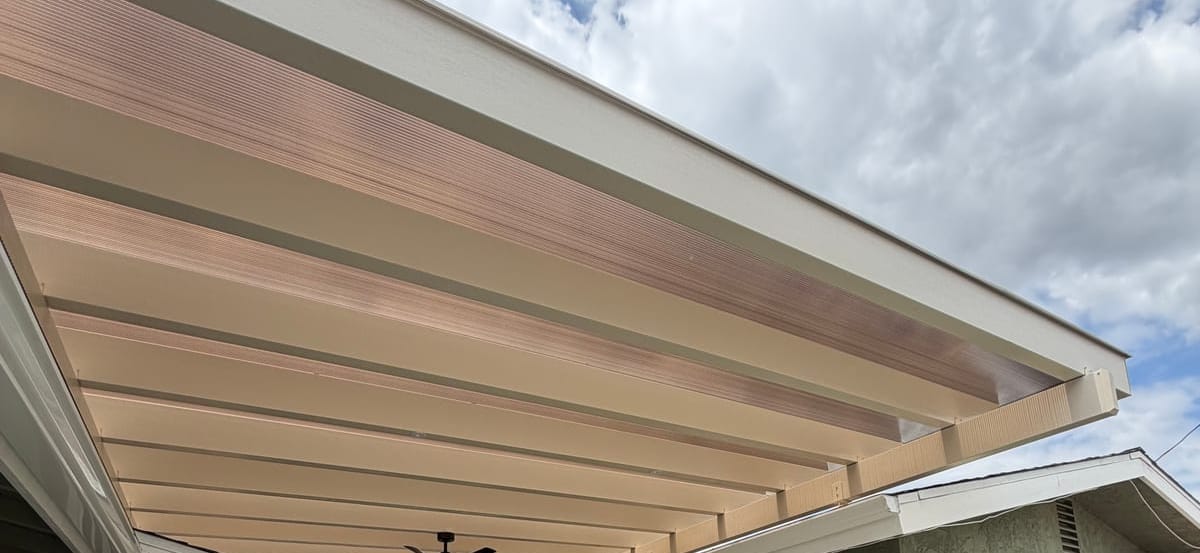
In fifteen-plus years of installs, we have never had a homeowner tell us their patio cover was too big. We hear the opposite regularly. Sizing is the decision most worth slowing down on, because unlike color or finish, it is the one you cannot change later without rebuilding.
Projection Is What Determines Shade
Projection is how far the cover extends out from the house. It is the dimension that decides whether you are actually in shade, and it is the one homeowners consistently underestimate.
The reason is sun angle. At solar noon in June, the sun in Southern California sits around 78° above the horizon and a cover casts shade almost straight down — a shallow cover works fine. By 4 PM the sun has dropped to roughly 30°, and shade gets thrown sideways rather than down. A 10-foot-deep cover at that angle leaves a large band of your patio in full sun.
Practical guidance by use:
- 10 to 12 feet: the minimum for a dining table with chairs pulled out. Below 10 feet you are covering a walkway, not a room.
- 12 to 16 feet: comfortable for a dining set plus circulation, or a lounge seating group.
- 16 to 20+ feet: what you need for separate dining and lounge zones, or a dining set that stays shaded through a west-facing afternoon.
Width: Match the Room, Not the Slab
Width is easier. The usual mistake is sizing to the existing concrete, which was often poured decades ago for a smaller patio. Better anchors:
- Span the full width of the room the patio serves, so the view from inside is symmetrical. A cover that stops two feet short of a slider edge looks like an afterthought from the kitchen.
- Add roughly 2 feet beyond the furniture group on each side. A 6-foot table wants 10 to 12 feet of covered width once chairs are pulled out.
- If you are adding an outdoor kitchen, measure the island plus bar stools plus room to walk behind the cook, and add that to the total.
Height: The Trade-Off Nobody Warns You About
Attached covers have to tuck under the existing eave and still slope enough to drain. On a single-story tract home with a low eave, that can put the outer edge under 8 feet, which feels lower than people expect once they are standing under it.
Two ways out: a freestanding structure set a few feet off the house, which can be built as tall as setbacks allow, or a raised-fascia detail that gains you height at the house connection. Both cost more. Both are worth discussing before you settle for 7 feet 6 inches.
Do this before you sign anything: lay a garden hose or a chalk line on the patio at your proposed projection, then go outside at the hour you most want to use the space in summer — usually somewhere between 3 and 5 PM — and see where the shadow of the house currently falls relative to that line. It takes ten minutes and it is the single most useful sizing exercise there is.
Setbacks and Lot Coverage
Cities cap how close a structure can sit to side and rear property lines, and many also cap total lot coverage. A cover that works beautifully on paper can lose two feet of projection at plan check. Get the setback numbers for your specific jurisdiction early — they vary considerably between, say, Irvine and La Habra — so the design is built around them rather than trimmed to fit them. Our permit guide covers the process.
Sizing and Cost
Patio covers price largely per square foot, so bigger genuinely costs more — but the increment is usually smaller than homeowners assume, because the fixed costs (mobilization, permit, footings, ledger work) are already spent. Going from 12 to 16 feet of projection is rarely a proportional price increase, and it is frequently the difference between a cover you use daily and one you wish you had built bigger. Cost breakdown here.
The Rule of Thumb
Size for the furniture you want under it plus circulation space, at the time of day you actually want to sit there, then add a couple of feet. Nobody regrets the extra two feet.
Related Articles
Get a Free On-Site Estimate
Serving Orange County, Los Angeles County, and surrounding communities. No pressure, no obligation — just expert advice and an accurate quote for your specific project.
Request Your Free Estimate